Artificial Intelligence (AI) has become a game-changer in various industries, and healthcare is no exception. One of the most promising subsets of AI in healthcare is Generative AI, a technology that enables machines to create data that mimics human-generated data. Generative AI utilizes deep learning algorithms to generate new content, such as images, text, and even human-like conversation. In this article, we will explore ten compelling use cases of Generative AI in healthcare, revolutionizing patient care and medical research.
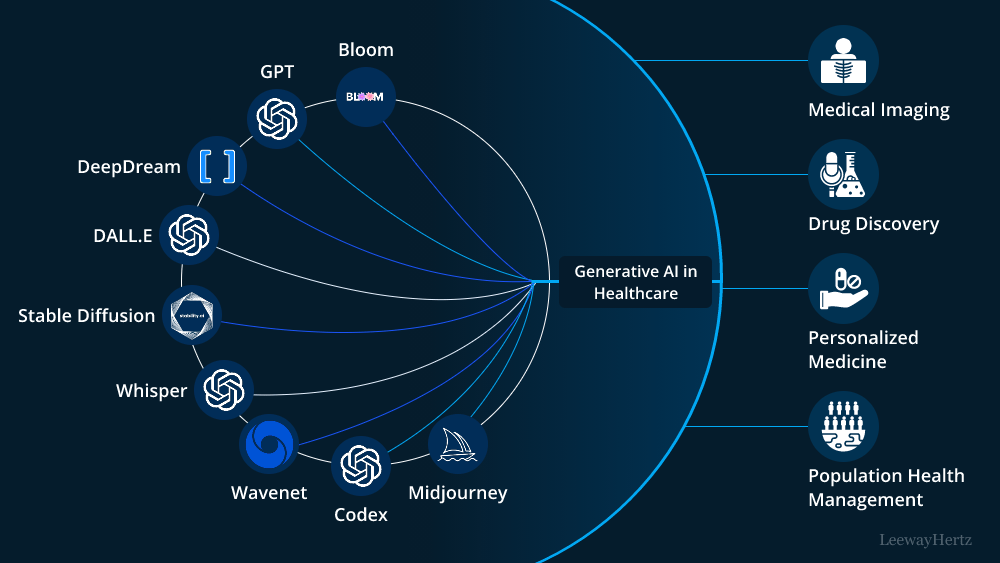
- Medical Image Generation
Generative AI can produce synthetic medical images that resemble real patient scans. These generated images can be used to augment limited datasets, train AI models, and test the robustness of algorithms. This capability is especially valuable in radiology, where access to large and diverse image datasets is crucial for accurate diagnostics and treatment planning.
- Drug Discovery and Development
Pharmaceutical companies are leveraging Generative AI to accelerate drug discovery and development. The technology can create molecular structures with specific properties, allowing researchers to design and optimize new drugs more efficiently. This leads to faster identification of potential drug candidates and expedites the process of bringing life-saving medications to market.
- Personalized Treatment Plans
Generative AI can analyze large-scale patient data, including electronic health records and genomic information, to create personalized treatment plans. By considering individual patient characteristics, such as genetic predispositions and lifestyle factors, healthcare providers can offer tailored and more effective treatment strategies.
- Medical Text Generation
Generating medical reports, summaries, and patient information using Generative AI can significantly reduce administrative burdens for healthcare professionals. The technology can quickly produce accurate and coherent medical texts, freeing up valuable time for doctors and nurses to focus on patient care.
- Medical Chatbots
Generative AI-powered medical chatbots are transforming the way patients interact with healthcare systems. These chatbots can simulate human-like conversations, answering questions, providing medical advice, and even assisting in diagnosing minor health issues. They enhance accessibility to healthcare services and can handle large volumes of patient queries simultaneously.
- Virtual Patient Simulations
Medical education benefits greatly from Generative AI by enabling the creation of virtual patient simulations. These simulations can mimic a wide range of medical conditions and scenarios, allowing medical students and healthcare professionals to practice complex procedures in a risk-free environment.
- Disease Progression Modeling
Predicting disease progression is critical for optimizing treatment plans and improving patient outcomes. Generative AI can analyze historical patient data and simulate disease progressions, aiding healthcare professionals in making informed decisions and interventions.
- AI-Generated Medical Devices
Generative AI plays a significant role in designing and optimizing medical devices. It can create innovative and customized designs for prosthetics, implants, and assistive technologies, tailored to each patient’s unique needs.
- Mental Health Support
Generative AI can be employed to create conversational agents that offer mental health support to individuals. These virtual counselors can provide empathetic conversations, assess emotional states, and offer coping strategies, contributing to the overall mental well-being of patients.
- Augmented Reality for Surgery
In surgical settings, Generative AI combined with augmented reality can enhance precision and efficiency. Surgeons can visualize complex anatomical structures and practice procedures using AI-generated 3D models, minimizing risks during actual surgeries.
Conclusion
Generative AI is rapidly transforming the landscape of healthcare, with its diverse applications enhancing patient care, medical research, and healthcare professionals’ productivity. From generating medical images to personalized treatment plans and virtual patient simulations, the potential of Generative AI in healthcare is vast. As technology continues to advance, we can expect even more groundbreaking use cases, ultimately leading to better health outcomes for patients worldwide. However, it’s crucial to balance innovation with ethical considerations to ensure patient safety and data privacy remain paramount in the integration of Generative AI into healthcare systems.
To Learn More:- https://www.leewayhertz.com/generative-ai-in-healthcare/

 Jasper's Tech world