Owner at Wilderness Market which is a vegan wellbeing food store situated in the core of the Georgetown, District of Columbia. and also an advisor of best Software development agencies to select for application designed on the basis on unique requirements.
Artificial Intelligence (AI) is reshaping the landscape of management consulting, offering unparalleled capabilities to analyze data, derive insights, and drive strategic decision-making. From optimizing operations to informing business strategies, AI technologies are revolutionizing how management consultants engage with clients and deliver value. This article explores the transformative impact of AI in management consulting, highlighting key applications, benefits, and considerations.
Data-Driven Insights:
Utilizing AI-powered analytics to process vast volumes of data and uncover actionable insights.
Predictive analytics and machine learning algorithms enable consultants to identify trends, patterns, and opportunities for optimization.
Real-time data analysis empowers consultants to make informed decisions and adapt strategies dynamically in response to changing market dynamics.
Process Optimization:
Applying AI-driven process automation to streamline workflows and eliminate manual inefficiencies.
Robotic Process Automation (RPA) automates repetitive tasks, freeing up consultants to focus on higher-value activities.
Cognitive automation technologies enhance decision-making by providing intelligent recommendations and suggestions based on data analysis.
Personalized Client Solutions:
Leveraging AI for personalized client solutions tailored to specific needs and objectives.
Recommender systems utilize client data and industry benchmarks to suggest optimal strategies and interventions.
Natural Language Processing (NLP) enables consultants to extract insights from unstructured data sources such as client documents, emails, and reports.
Risk Management and Compliance:
Employing AI-driven risk assessment tools to evaluate and mitigate operational, financial, and regulatory risks.
Compliance monitoring systems utilize AI algorithms to detect anomalies and ensure adherence to regulatory standards.
AI-powered decision support systems provide consultants with data-driven recommendations and scenario analysis.
Simulation models enable consultants to test different strategies and assess their potential impact on business outcomes.
Augmented intelligence platforms enhance human decision-making by integrating AI insights with domain expertise and intuition.
Client Engagement and Collaboration:
AI-enabled collaboration tools facilitate seamless communication and knowledge sharing among consultants and clients.
Virtual collaboration platforms leverage AI technologies such as natural language processing and sentiment analysis to enhance remote collaboration experiences.
Virtual assistants provide personalized support to consultants and clients, improving productivity and responsiveness.
Ethical and Regulatory Considerations:
Ensuring ethical AI deployment by addressing biases, transparency, and accountability in AI algorithms.
Compliance with data privacy regulations (e.g., GDPR, CCPA) and industry standards in data handling and analysis.
Responsible use of AI to maintain client trust and uphold professional integrity in consulting engagements.
Conclusion:
As AI continues to evolve and mature, management consulting firms must embrace AI-driven innovation to stay competitive and deliver value-added services to clients. By harnessing the power of AI for data-driven insights, process optimization, personalized solutions, and strategic decision support, consultants can drive business transformation and help clients navigate the complexities of today’s dynamic business environment. However, it’s essential to approach AI deployment with careful consideration of ethical, regulatory, and privacy implications, ensuring that AI technologies are leveraged responsibly to empower consultants and drive positive outcomes for clients.
In today’s rapidly evolving insurance landscape, artificial intelligence (AI) is emerging as a game-changer, revolutionizing traditional processes and reshaping customer interactions. From underwriting and claims management to risk mitigation and customer service, AI is driving efficiency and improving experiences across the insurance value chain.
AI-powered underwriting has transformed risk assessment, leveraging predictive analytics and machine learning algorithms to analyze vast datasets for accurate risk profiling. This enables insurers to offer personalized policies based on individual behaviors and preferences, enhancing customer satisfaction and retention.
Customer experience has been significantly enhanced through AI-driven solutions like chatbots and virtual assistants, providing seamless interactions and personalized recommendations. Automated claims processing expedites settlements, while fraud detection algorithms identify suspicious activities early, minimizing losses and improving trust.
AI isn’t just about efficiency—it’s also about risk mitigation. IoT devices and telematics monitor insured assets in real-time, enabling predictive maintenance and reducing the likelihood of losses. Moreover, AI helps insurers stay compliant with regulations like GDPR and ensures fair and ethical decision-making.
Looking ahead, the future of AI in insurance is promising. Advancements in deep learning and collaboration with insurtech startups promise even more innovation. However, ethical considerations remain paramount, ensuring that AI is deployed responsibly to benefit both insurers and policyholders alike.
In conclusion, AI is reshaping the insurance industry, driving efficiency, and improving customer experiences. Embracing AI-enabled solutions will be crucial for insurers to stay competitive in an increasingly digital world while maintaining trust and transparency with their customers.
In the financial sector, managing credit risk is paramount for ensuring the stability and profitability of lending institutions. Traditionally, credit risk assessment relied heavily on statistical methods and expert judgment. However, with the advancements in machine learning (ML) and artificial intelligence (AI), financial institutions are increasingly turning to these technologies to enhance their credit risk modeling processes. In this article, we will delve into the intricacies of building credit risk models using machine learning techniques.
Introduction to Credit Risk Models:
Credit risk models are mathematical frameworks used by lenders to assess the likelihood of a borrower defaulting on a loan or failing to meet their financial obligations. These models analyze various factors such as the borrower’s credit history, income, debt-to-income ratio, and economic indicators to quantify the level of risk associated with extending credit to an individual or business.
Challenges in Traditional Credit Risk Modeling:
Traditional credit risk models often face challenges in accurately predicting creditworthiness due to their reliance on simplistic statistical techniques and limited data sources. These models may fail to capture the complex interrelationships between different variables and are susceptible to biases and inconsistencies in judgment.
Role of Machine Learning in Credit Risk Modeling:
Machine learning algorithms offer several advantages over traditional statistical methods in credit risk modeling:
Improved Accuracy: ML algorithms can analyze large volumes of data and identify intricate patterns that may not be apparent to human analysts, leading to more accurate risk assessments.
Flexibility: ML models can adapt to changing market conditions and evolving borrower behaviors, providing lenders with more dynamic and responsive risk management tools.
Feature Engineering: ML techniques allow for the creation of sophisticated features by combining and transforming raw data, enabling the model to capture nuanced relationships between variables.
Automation: ML models can automate various aspects of the credit risk assessment process, reducing the need for manual intervention and streamlining decision-making workflows.
Key Steps in Building Credit Risk Models Using Machine Learning:
Data Collection and Preprocessing:
Gather relevant data sources such as credit reports, income statements, and economic indicators.
Cleanse and preprocess the data to remove missing values, outliers, and inconsistencies.
Normalize or standardize the features to ensure uniformity in scale and distribution.
Feature Selection and Engineering:
Identify the most informative features through exploratory data analysis and feature importance techniques.
Engineer new features by combining or transforming existing variables to capture complex relationships.
Use domain knowledge to incorporate relevant external data sources that may enhance predictive performance.
Model Selection and Training:
Choose appropriate machine learning algorithms such as logistic regression, decision trees, random forests, or gradient boosting machines.
Split the data into training and validation sets to assess the performance of different models.
Fine-tune hyperparameters using techniques like grid search or random search to optimize model performance.
Model Evaluation and Validation:
Evaluate the trained models using performance metrics such as accuracy, precision, recall, and area under the receiver operating characteristic curve (AUC-ROC).
Validate the models on out-of-sample data to assess their generalization ability and robustness.
Deployment and Monitoring:
Deploy the trained model into production environments, integrating it with existing credit decision systems.
Continuously monitor model performance and recalibrate as needed to maintain accuracy and effectiveness over time.
Ethical Considerations and Regulatory Compliance:
When developing and deploying machine learning models for credit risk assessment, it is crucial to address ethical considerations such as fairness, transparency, and bias mitigation. Lenders must ensure that their models do not discriminate against protected classes and comply with relevant regulations such as the Equal Credit Opportunity Act (ECOA) and the Fair Credit Reporting Act (FCRA).
Conclusion:
Machine learning holds immense potential for revolutionizing credit risk modeling in the financial industry. By harnessing the power of advanced algorithms and big data analytics, lenders can make more informed and timely credit decisions, leading to improved risk management and better outcomes for borrowers and investors alike. However, it is essential to approach the development and implementation of ML-based credit risk models with caution, taking into account ethical considerations, regulatory requirements, and the need for ongoing monitoring and refinement.
In recent years, Artificial Intelligence (AI) has emerged as a transformative force in the financial industry, reshaping the landscape of traditional practices and offering innovative solutions to age-old challenges. From wealth management to decision-making, compliance, credit scoring, accounting, auditing, financial modeling, and planning, AI is weaving its way into the intricate fabric of finance. In this article, we delve into the diverse use cases of AI in finance and explore how this technology is bringing about a paradigm shift in the industry.
AI in Wealth Management:
Wealth management has traditionally been a relationship-driven business, but AI is revolutionizing how financial advisors assist clients in growing and preserving their assets. AI in wealth management analyze vast amounts of data to provide personalized investment advice, taking into account individual risk tolerances, financial goals, and market trends. With AI-driven tools, wealth managers can optimize portfolios, allocate assets more efficiently, and offer timely insights to clients.
AI in Decision-Making:
AI in decision making is enhancing the processes in finance. Machine learning algorithms analyze historical data, market trends, and real-time information to make predictions and assist financial professionals in making informed decisions. This not only speeds up decision-making but also reduces the impact of emotional biases, contributing to more objective and data-driven choices.
AI in Financial Compliance:
The financial industry is highly regulated, and compliance is a critical aspect of its operations. AI in financial compliance plays a vital role in automating compliance processes, ensuring that financial institutions adhere to the ever-evolving regulatory landscape. Machine learning algorithms can detect anomalies, monitor transactions, and flag potential risks, enhancing the efficiency of compliance teams and reducing the likelihood of regulatory breaches.
AI-Based Credit Scoring:
Traditionally, credit scoring has been based on historical data and predefined criteria. AI based credit scoring is transforming this process by incorporating a broader range of variables and real-time data. Machine learning models can analyze non-traditional data sources, such as social media activity and online behavior, to assess an individual’s creditworthiness more accurately. This not only improves risk assessment but also expands access to credit for individuals with limited credit histories.
AI in Accounting and Auditing:
AI in accounting and auditing is streamlining these processes by automating routine tasks, reducing errors, and enhancing the accuracy of financial reporting. Natural Language Processing (NLP) algorithms can extract valuable insights from unstructured financial data, making it easier for auditors to identify potential risks and anomalies. This not only increases the efficiency of auditing but also enhances the overall reliability of financial statements.
AI in Financial Modeling:
Financial modeling is a complex and time-consuming task that often requires extensive manual effort. AI in financial modeling uses tools that can automate the creation of models, allowing financial professionals to focus on strategic analysis and decision-making. Machine learning algorithms can also improve the accuracy of financial forecasts by learning from historical data and adjusting predictions based on changing market conditions.
AI in Financial Planning:
AI is transforming the way individuals plan for their financial futures. Robo-advisors, powered by AI algorithms, offer automated and personalized financial planning services. These platforms assess clients’ financial situations, goals, and risk tolerances to provide tailored investment and savings strategies. AI in financial planning empower individuals to make informed decisions about budgeting, investing, and achieving their long-term financial objectives.
Conclusion:
AI is proving to be a game-changer in the financial industry, optimizing processes, reducing risks, and empowering both professionals and consumers. As AI continues to evolve, its impact on wealth management, decision-making, compliance, credit scoring, accounting, auditing, financial modeling, and planning will likely become even more pronounced. Financial institutions and professionals embracing these AI-driven solutions are poised to lead the way in this exciting era of technological innovation within the finance sector.
As the legal industry undergoes a digital transformation, Artificial Intelligence (AI) is playing a pivotal role in reshaping traditional practices and optimizing critical processes. This article delves into four key AI use cases within the legal landscape: AI for Legal Research, AI for Regulatory Compliance, Generative AI for Compliance, and AI for Contract Management. Each use case brings unique advantages, contributing to efficiency, accuracy, and adaptability within the legal realm.
AI for Legal Research
Traditional Challenges in Legal Research
Legal professionals traditionally faced challenges in sifting through vast amounts of legal texts, case law, and statutes. The time-consuming nature of manual legal research often hindered the efficiency of legal professionals.
AI’s Impact on Legal Research
AI for legal research brings a revolutionary change by leveraging Natural Language Processing (NLP) and machine learning algorithms. These technologies enable AI systems to comprehend, analyze, and extract meaningful insights from extensive legal databases. Legal professionals can now access relevant information swiftly, enhancing the speed and accuracy of legal research processes.
AI for Regulatory Compliance
Navigating the Complexities of Compliance
Regulatory compliance is a cornerstone of the legal industry, and adherence to ever-evolving regulations poses significant challenges. Staying abreast of regulatory changes, ensuring compliance, and mitigating associated risks are constant concerns for legal professionals.
AI’s Role in Regulatory Compliance
AI in regulatory compliance aids by automating the monitoring of legal and regulatory changes. Machine learning algorithms analyze updates, providing real-time insights into changes that may impact businesses. This proactive approach ensures that legal professionals can adapt compliance strategies swiftly, reducing the risk of non-compliance and associated penalties.
Generative AI for Compliance
Traditional Compliance Approaches
Traditional compliance processes often relied on manual interpretation of regulations, leading to potential gaps in understanding and implementation. The lack of adaptability to changing regulatory landscapes posed risks for businesses.
Transformative Impact of Generative AI
Generative AI for compliance introduces a dynamic approach by simulating various compliance scenarios. By generating synthetic datasets based on regulatory requirements, AI models assist legal professionals in testing and refining compliance strategies. This proactive approach ensures that businesses can anticipate and address compliance challenges, fostering a more resilient and adaptable compliance framework.
AI for Contract Management
Challenges in Traditional Contract Management
Manual contract management processes were time-consuming, prone to errors, and lacked the agility required in a fast-paced business environment. Tracking contractual obligations, managing revisions, and ensuring compliance with contractual terms were complex tasks.
Enhancing Contract Management with AI
AI for contract management streamlines the process by automating routine tasks and providing intelligent insights. Natural Language Processing enables AI systems to understand and extract key information from contracts, facilitating efficient management and analysis. Automated contract review and monitoring contribute to accuracy, speed, and risk mitigation in the contract management lifecycle.
Achieving Synergy Across AI Use Cases
Creating a Holistic Legal Tech Ecosystem
The integration of these AI use cases creates a powerful synergy within the legal industry. For example, insights from AI-driven legal research can inform compliance strategies, ensuring that regulatory changes are seamlessly integrated into legal processes. Generative AI for compliance and AI-enhanced contract management further contribute to the overall adaptability and resilience of legal frameworks.
Conclusion
The intersection of AI and the legal industry is paving the way for a more efficient, adaptive, and future-ready legal landscape. AI for Legal Research, AI for Regulatory Compliance, Generative AI for Compliance, and AI for Contract Management are transforming traditional practices, empowering legal professionals with unprecedented tools and insights. As legal tech continues to evolve, the symbiotic relationship between these AI use cases promises to redefine the way legal professionals navigate complexities, ensuring a more agile, accurate, and strategic approach to legal challenges.
Artificial Intelligence (AI) has emerged as a transformative force within the finance industry, revolutionizing traditional practices and paving the way for unprecedented efficiency and accuracy. In this article, we will delve into several crucial use cases of AI in finance, focusing on demand forecasting, generative AI in asset management, private equity and principal investment, portfolio management, due diligence, fraud detection, and risk management.
AI in Demand Forecasting
AI in Demand forecasting is reshaping this process which is a critical aspect of financial planning:
a. Data-Driven Predictions: AI algorithms analyze historical sales data, market trends, and external factors to generate accurate demand forecasts. This data-driven approach enables financial professionals to make informed decisions, optimize inventory levels, and align resources with anticipated demand.
b. Dynamic Adjustments: AI in demand forecasting allows for dynamic adjustments based on real-time data. This adaptability is crucial in responding to sudden changes in market conditions, ensuring that financial plans remain agile and reflective of the current business environment.
c. Supply Chain Optimization: By providing accurate demand forecasts, AI aids in optimizing the supply chain. Manufacturers and retailers can streamline production and inventory processes, reducing costs and minimizing the risk of overstocking or stockouts.
Generative AI in Asset Management
Generative AI, a subset of AI that involves creating new content, is making significant strides in asset management. Major use cases of AI in asset management:
a. Algorithmic Trading Strategies: Generative AI designs algorithmic trading strategies by analyzing historical market data and identifying patterns. This innovative approach allows asset managers to develop unique trading algorithms that adapt to changing market conditions.
b. Portfolio Optimization: Generative AI enhances portfolio optimization by creating diverse investment strategies. These strategies are generated based on historical performance data, risk tolerance, and market trends, leading to more robust and adaptive investment portfolios.
c. Scenario Analysis: Generative AI facilitates scenario analysis by creating simulated market conditions. This allows asset managers to assess the potential impact of various economic scenarios on investment portfolios, enabling more informed decision-making.
AI Use Cases in Private Equity and Principal Investment
a. Deal Sourcing and Evaluation: AI analyzes vast datasets to identify potential investment opportunities. By assessing market trends, financial performance, and other relevant factors, AI streamlines the deal sourcing and evaluation process for private equity and principal investment firms.
b. Risk Assessment: AI models assess the risk associated with potential investments by analyzing historical data, market conditions, and industry trends. This data-driven risk assessment enhances decision-making and allows investors to make more informed choices.
c. Portfolio Management: AI aids in portfolio management by continuously monitoring the performance of investments. It provides real-time insights, helping private equity and principal investment firms optimize their portfolios and maximize returns.
a. Automated Decision-Making: AI automates decision-making processes in portfolio management by analyzing vast amounts of data quickly and efficiently. This automation leads to more timely and informed investment decisions.
b. Dynamic Asset Allocation: AI-driven algorithms adjust asset allocations dynamically based on changing market conditions. This adaptability ensures that portfolios remain aligned with investment objectives and risk tolerance.
c. Performance Monitoring: AI continuously monitors the performance of assets within a portfolio. By analyzing historical data and market trends, it provides insights that assist portfolio managers in optimizing their investment strategies.
AI in Due Diligence
Due diligence, a crucial step in investment processes, is enhanced by incorporation of AI in due diligence its the ability to analyze vast datasets and uncover valuable insights:
a. Document Analysis: AI automates document analysis during due diligence by extracting and interpreting relevant information from contracts, financial statements, and legal documents. This accelerates the due diligence process and reduces the risk of overlooking critical details.
b. Risk Assessment: AI evaluates potential risks associated with an investment by analyzing historical data and market conditions. This proactive approach allows investors to identify and mitigate risks early in the due diligence process.
c. Efficiency and Accuracy: AI streamlines due diligence processes, reducing the time and resources required for comprehensive assessments. Automated data analysis ensures accuracy and minimizes the risk of human error during due diligence activities.
AI in Fraud Detection
Fraud detection is a persistent challenge in the finance industry, and AI in fraud detection is proving to be a formidable ally in identifying and preventing fraudulent activities:
a. Anomaly Detection: AI employs machine learning algorithms to identify anomalies in transaction patterns, account behavior, and other financial activities. This proactive approach enhances fraud detection capabilities, allowing financial institutions to respond swiftly to potential threats.
b. Pattern Recognition: AI analyzes vast datasets to recognize patterns associated with fraudulent activities. By continuously learning from new data, AI models become increasingly adept at identifying emerging fraud trends, providing a robust defense against evolving threats.
c. Real-time Monitoring: AI enables real-time monitoring of financial transactions, allowing for immediate identification of suspicious activities. This rapid response minimizes the impact of fraud and enhances overall security in the financial ecosystem.
AI in Risk Management
Risk management is a cornerstone of financial stability, and AI in risk management brings advanced analytics and predictive modeling to the forefront of risk assessment:
a. Predictive Analytics: AI leverages predictive analytics to assess potential risks by analyzing historical data, market conditions, and external factors. This forward-looking approach enables financial institutions to anticipate and mitigate risks before they escalate.
b. Portfolio Risk Assessment: AI evaluates the risk associated with investment portfolios by considering various factors, including market volatility, economic trends, and asset correlations. This comprehensive risk assessment ensures that portfolios are aligned with risk tolerance and investment objectives.
c. Regulatory Compliance: AI assists in regulatory compliance by continuously monitoring changes in regulations and assessing their impact on risk management practices. This proactive approach ensures that financial institutions remain compliant with evolving regulatory requirements.
Conclusion
The integration of AI across various facets of the finance industry is reshaping traditional practices and setting new standards for efficiency, accuracy, and strategic decision-making. From demand forecasting and generative AI in asset management to private equity and principal investment, portfolio management, due diligence, fraud detection, and risk management, AI is proving to be a versatile and indispensable tool. As financial institutions continue to embrace the potential of AI, the industry is poised for further innovation, creating a future where the synergy of human expertise and artificial intelligence propels finance into new realms of success and resilience.
In the rapidly evolving landscape of the telecommunications industry, staying ahead of the curve is imperative. Generative AI, a cutting-edge technology, is making waves and reshaping the future of telecom. In this article, we’ll explore the various benefits and use cases of Generative AI in the telecom sector.
Generative AI Use Cases in Telecom
Enhanced Network Optimization
Generative AI is proving to be a game-changer in optimizing telecom networks. By analyzing vast datasets, it identifies patterns and predicts potential network issues, allowing for proactive maintenance and minimizing downtime. This results in improved network reliability and customer satisfaction.
Predictive Maintenance
One of the significant use cases of Generative AI in telecom is predictive maintenance. Through continuous monitoring, the AI predicts equipment failures before they occur, enabling telecom companies to schedule timely maintenance, reduce costs, and prevent service disruptions.
Network Security
Generative AI plays a crucial role in bolstering the security of telecom networks. By analyzing network traffic patterns, it can detect anomalies and potential security threats in real-time. This proactive approach is essential in safeguarding sensitive customer data and maintaining the integrity of the network.
Generative AI for Telecom
Customer Experience Enhancement
The telecom industry is fiercely competitive, and providing an exceptional customer experience is paramount. Generative AI analyzes customer interactions, understands preferences, and tailors services accordingly. This personalized approach enhances customer satisfaction and loyalty.
Automated Customer Support
Generative AI-driven chatbots are transforming customer support in the telecom sector. These intelligent bots can handle routine queries, troubleshoot issues, and provide instant assistance, freeing up human agents to focus on more complex tasks. This leads to quicker issue resolution and improved overall customer service.
Demand Forecasting
Accurate demand forecasting is essential for telecom companies to optimize resources and plan for network expansion. Generative AI leverages historical data and market trends to predict future demand, enabling telecom providers to allocate resources efficiently and stay ahead of consumer needs.
Role of Generative AI in Telecom
Network Expansion and Planning
Generative AI assists telecom companies in planning network expansions strategically. By analyzing data on usage patterns and population growth, it predicts areas of high demand. This foresight allows telecom providers to invest in infrastructure where it’s most needed, optimizing resources and improving service delivery.
Cost Reduction
The implementation of Generative AI in telecom contributes to significant cost reductions. Through predictive maintenance, automated support, and optimized resource allocation, companies can streamline operations and reduce unnecessary expenditures. This efficiency translates into improved profitability for telecom businesses.
Innovation in Services
Generative AI opens the door to innovative services in the telecom sector. From the development of smart applications to the integration of augmented reality in telecommunications, AI-driven advancements redefine the services offered. This innovation not only attracts customers but also positions telecom companies as industry leaders.
Conclusion
Generative AI is a transformative force in the telecom industry, offering a myriad of benefits that range from enhanced network optimization to personalized customer experiences. As telecom companies continue to embrace this technology, they position themselves at the forefront of innovation, ensuring a competitive edge in the dynamic telecommunications landscape. The role of Generative AI in telecom is not just about technological advancement; it’s about reshaping the future of communication.
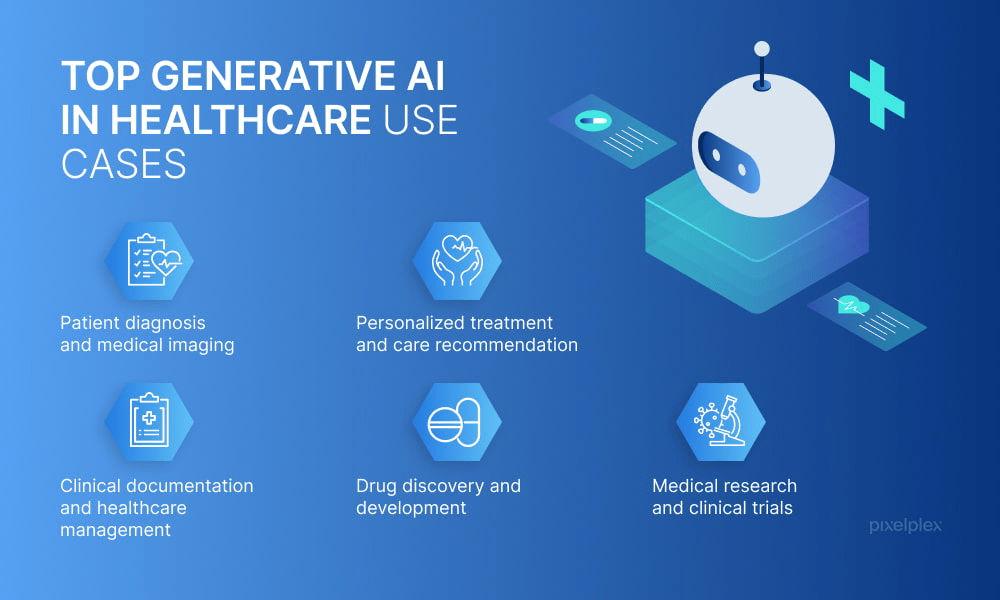
In the ever-evolving landscape of healthcare, technological advancements play a pivotal role in enhancing patient outcomes and optimizing operational efficiency. Generative AI, a cutting-edge technology, is making waves in the healthcare sector, revolutionizing the way medical professionals approach diagnostics, treatment planning, and personalized medicine. This article delves into the benefits and diverse use cases of Generative AI in healthcare.
Understanding Generative AI in Healthcare
Generative AI refers to a subset of artificial intelligence that focuses on creating new content, such as images, text, or even medical data, that is indistinguishable from human-generated content. In healthcare, the applications of Generative AI are vast and transformative, impacting various aspects of patient care and medical research.
Generative AI Use Cases in Healthcare
1. Enhanced Medical Imaging: Generative AI has significantly elevated the accuracy of medical imaging interpretation. By leveraging vast datasets, it assists radiologists in detecting anomalies, tumors, and abnormalities with greater precision. This technology ensures early diagnosis, leading to more effective and timely treatment interventions.
2. Drug Discovery and Development: In the realm of pharmaceuticals, Generative AI accelerates drug discovery processes. It analyzes complex biological data to identify potential drug candidates, streamlining research efforts and reducing the time and resources required for bringing new medications to market.
3. Personalized Treatment Plans: The role of Generative AI extends to tailoring treatment plans based on individual patient characteristics. By analyzing genetic data, medical histories, and lifestyle factors, this technology enables healthcare professionals to create personalized interventions that maximize efficacy and minimize side effects.
Generative AI for Healthcare: A Game-Changer
The integration of Generative AI into healthcare practices marks a paradigm shift in patient care. Its ability to generate realistic and contextually relevant data has the potential to redefine how medical professionals approach diagnostics and treatment strategies.
Role of Generative AI in Healthcare
1. Overcoming Data Limitations: One of the significant challenges in healthcare is the limited availability of diverse and extensive datasets. Generative AI addresses this issue by creating synthetic data, allowing algorithms to train on a broader spectrum of scenarios. This, in turn, enhances the robustness and generalization of AI models.
2. Facilitating Continuous Learning: Generative AI enables machine learning models to evolve and improve continuously. By generating new training data and adapting to real-world variations, these models become more adept at handling complex medical scenarios, ultimately leading to more reliable and accurate results.
3. Ethical Data Sharing: In healthcare, patient privacy and data security are paramount. Generative AI offers a solution by allowing the generation of synthetic data that maintains the statistical properties of the original dataset without compromising patient confidentiality. This facilitates ethical data sharing for collaborative research endeavors.
Challenges and Future Directions
While the benefits of Generative AI in healthcare are substantial, challenges such as ethical considerations, interpretability of generated data, and regulatory frameworks must be addressed. The healthcare industry must collaboratively work towards establishing guidelines and standards to ensure the responsible and ethical use of Generative AI.
Conclusion
Generative AI’s impact on healthcare is undeniable, ushering in a new era of possibilities for improved patient care, diagnostics, and medical research. As technology continues to advance, the synergy between Generative AI and healthcare promises a future where personalized and precise medicine is the standard rather than the exception. Embracing this transformative technology is not just a choice; it’s a step towards a healthier and more resilient healthcare ecosystem.
Introduction: A Technological Revolution in Education
In the ever-evolving landscape of education, Artificial Intelligence (AI) has emerged as a transformative force, offering a myriad of benefits to students, educators, and institutions alike. This article delves into the multifaceted aspects of AI in education, exploring key use cases, its significant role, and the tangible advantages it brings to the table.
I. AI Use Cases in Education
1. Personalized Learning
AI’s ability to analyze individual learning patterns facilitates personalized learning experiences. Adaptive learning platforms leverage AI algorithms to tailor educational content, pacing, and assessments, ensuring students receive customized support that aligns with their unique strengths and weaknesses.
2. Intelligent Tutoring Systems
AI-driven tutoring systems serve as virtual mentors, providing students with real-time assistance. These systems adapt to the learner’s progress, offering targeted guidance and support, ultimately enhancing comprehension and retention of academic material.
3. Automating Administrative Tasks
AI streamlines administrative processes, allowing educators to focus on teaching. From grading assignments to managing schedules, AI-powered tools alleviate the burden of routine tasks, fostering a more efficient and productive learning environment.
II. AI for Education: Transforming Teaching Practices
1. Enhanced Learning Materials
AI contributes to the creation of dynamic and interactive learning materials. Virtual reality (VR) and augmented reality (AR) applications powered by AI offer immersive experiences, making complex subjects more engaging and understandable for students.
2. Intelligent Content Creation
Educators can harness AI to generate educational content. Natural Language Processing (NLP) enables the creation of high-quality lesson plans, quizzes, and assessments, saving time and promoting the continuous development of relevant and effective teaching materials.
3. Early Intervention for Students at Risk
AI tools can identify students who may be struggling academically or emotionally by analyzing various data points. Early intervention allows educators to provide timely support, preventing potential challenges from escalating.
III. The Role of AI in Education
1. Facilitating Data-Driven Decision Making
AI processes vast amounts of data to provide insights into student performance, learning trends, and areas for improvement. Educators and administrators can make informed decisions based on these analytics, ultimately enhancing the overall educational experience.
2. Customizing Professional Development
AI supports the continuous growth of educators by tailoring professional development programs. By analyzing teaching styles, student interactions, and learning outcomes, AI recommends targeted training to enhance teaching methods and keep educators abreast of the latest pedagogical trends.
3. Fostering Inclusivity
AI tools contribute to creating a more inclusive learning environment. Language translation services, speech recognition, and other AI-driven features break down language barriers, making education accessible to a diverse global audience.
IV. Benefits Galore: The Advantages of AI in Education
1. Improved Student Engagement
Personalized learning, interactive content, and innovative teaching methods driven by AI captivate students’ attention, fostering increased engagement and enthusiasm for learning.
2. Efficient Resource Allocation
Automation of administrative tasks allows educational institutions to allocate resources more efficiently. This, in turn, enables the redirection of time and funds towards initiatives that directly enhance the quality of education.
3. Continuous Learning Opportunities
AI facilitates continuous learning beyond traditional classroom settings. Online courses, intelligent tutoring systems, and digital resources empower students to pursue education at their own pace, breaking down geographical barriers.
Conclusion: Embracing the Future of Education
As AI continues to permeate the educational landscape, its benefits become increasingly evident. From personalized learning experiences to transformative teaching practices and informed decision-making, the role of AI in education is pivotal. Embracing these technological advancements opens up a world of possibilities, ensuring that the future of education is not only innovative but also inclusive and accessible to all.
In the dynamic landscape of technology, few innovations have garnered as much attention and potential as blockchain. This revolutionary technology has transcended its initial association with cryptocurrencies and emerged as a transformative force across diverse industries. At the heart of this technological evolution are Blockchain Development Companies, entities driving innovation, and reshaping the digital landscape. In this comprehensive guide, we delve into the world of these companies, their significance, and the key factors that define their success.
Understanding Blockchain Development Companies
Blockchain, at its core, is a decentralized, immutable ledger that records transactions across a network of computers. Blockchain Development Companies are instrumental in harnessing this technology’s potential by creating customized blockchain solutions tailored to various business needs. These companies employ skilled developers, architects, and experts adept at crafting blockchain-based applications and infrastructures.
Key Attributes of Leading Blockchain Development Companies
Expertise and Experience: Top-tier blockchain development firms boast a team of seasoned professionals proficient in various blockchain platforms, such as Ethereum, Hyperledger, and Corda. Their experience spans across industries, enabling them to offer insights and solutions aligned with specific business requirements.
Innovative Solutions: The hallmark of a distinguished blockchain development company lies in its ability to deliver innovative solutions. These firms not only create blockchain applications but also offer consultancy services, guiding businesses in leveraging blockchain’s potential to streamline operations, enhance security, and foster transparency.
Customization and Scalability: One-size-fits-all approaches do not work in the realm of blockchain. Leading companies excel in developing bespoke solutions tailored to individual business needs while ensuring scalability to accommodate future growth and demands.
Security and Compliance: Security is paramount in blockchain technology. Reputable companies prioritize robust security measures and compliance with regulatory standards, instilling trust and reliability in their solutions.
Transparent Processes: Effective communication and transparent processes are integral to successful collaborations. Leading companies maintain clear communication channels and provide regular updates, ensuring clients are involved throughout the development lifecycle.
Industries Transformed by Blockchain Development Companies
Blockchain’s transformative potential extends across various sectors:
Finance and Banking: Revolutionizing payments, remittances, and trade finance through decentralized financial solutions.
Healthcare: Enhancing patient data security, interoperability, and supply chain transparency.
Supply Chain and Logistics: Enabling real-time tracking, transparency, and efficiency in logistics operations.
Real Estate: Simplifying property transactions, title management, and eliminating fraudulent practices.
Gaming and Entertainment: Creating decentralized platforms for secure in-game asset ownership and transparent royalty distribution.
Selecting the Right Blockchain Development Partner
Choosing the ideal blockchain development company involves careful consideration of several factors:
Track Record and Portfolio: Evaluate past projects, client testimonials, and industry reputation.
Technical Proficiency: Assess expertise in specific blockchain platforms and technologies relevant to your project.
Communication and Collaboration: Ensure effective communication channels and a collaborative approach.
Scalability and Support: Consider long-term support and scalability options for your project’s future needs.
Conclusion
Blockchain Development Companies stand at the forefront of technological innovation, reshaping industries, and unlocking new possibilities. As businesses increasingly recognize the potential of blockchain technology, the role of these companies becomes ever more crucial. Selecting the right partner is pivotal in navigating the complexities of blockchain integration, and understanding the key attributes and industry-specific expertise of these firms is imperative for successful collaborations.
In essence, the world of blockchain development companies represents a nexus of innovation, expertise, and transformative potential, poised to redefine the future of business operations across the globe.




 Jasper's Tech world