How to Use the Decision Transformer in a Transformer?

The Transformer model, introduced by Vaswani et al. in 2017, revolutionized natural language processing tasks and brought significant advancements in various AI fields. It uses a self-attention mechanism to process input sequences and capture long-range dependencies effectively. However, as machine learning models have evolved, researchers have explored ways to make Transformers more powerful and efficient.

One such advancement is the Decision Transformer, a variant of the Transformer architecture that incorporates decision-making capabilities. The Decision Transformer extends the traditional self-attention mechanism to include explicit handling of decisions and outcomes, making it well-suited for tasks that involve sequential decision-making. In this article, we will explore how to use the Decision Transformer in a Transformer for various applications.

Understanding the Decision Transformer

The Decision Transformer builds upon the standard Transformer model and introduces additional components to handle decisions during sequence processing. It incorporates decision heads that can influence the model’s behavior based on prior outcomes. This allows the Decision Transformer to excel in tasks with multiple decision points and conditional dependencies.

Step 1: Model Architecture

The first step in using the Decision Transformer is to understand its architecture. Like the original Transformer, it consists of an encoder-decoder architecture with self-attention layers. However, the Decision Transformer extends this by adding decision heads to the self-attention mechanism. These decision heads take into account the decisions made at each step and use this information to guide the model’s future decisions.

Step 2: Data Preparation

Before using the Decision Transformer, ensure that your data is appropriately prepared for the specific task you want to tackle. For sequential decision-making tasks, the dataset should include examples with decision points and corresponding outcomes. Each decision point should be associated with a specific token in the input sequence.

Step 3: Implementing Decision Heads

To incorporate decision-making capabilities, you need to modify the self-attention mechanism of the Transformer. In each self-attention layer, decision heads are introduced to capture the decisions made at each step. These decision heads take the form of additional attention mechanisms that consider the previous decisions and their outcomes.

Step 4: Training the Model

Once the Decision Transformer is implemented, the next step is to train the model on your prepared dataset. During training, the model learns to make decisions based on the provided outcomes at each decision point. This process helps the model develop a deeper understanding of conditional dependencies and improves its sequential decision-making capabilities.

Step 5: Evaluation and Fine-Tuning

After training the Decision Transformer, evaluate its performance on the task at hand. The evaluation metrics will depend on the specific application, but they should take into account both the accuracy of decisions and the overall task performance.

If the model’s performance is not satisfactory, consider fine-tuning it on additional data or adjusting hyperparameters to improve its decision-making abilities.

Applications of Decision Transformers

Decision Transformers find applications in various fields due to their ability to handle sequential decision-making tasks effectively. Some notable applications include:

  1. Autonomous Systems: Decision Transformers can be used in autonomous vehicles and robots, enabling them to make complex decisions in real-time based on sensor inputs and prior outcomes.
  2. Financial Modeling: In finance, Decision Transformers can aid in making investment decisions by considering historical outcomes and market conditions.
  3. Medical Diagnosis: Decision Transformers can be employed in medical diagnosis systems, taking into account patient history and test results to arrive at accurate diagnoses.
  4. Natural Language Processing: In NLP, Decision Transformers can be used for tasks involving multiple decision points, such as dialogue generation and question-answering systems.

Conclusion

The Decision Transformer extends the capabilities of the traditional Transformer model by incorporating decision-making mechanisms. By explicitly considering decisions and outcomes, the Decision Transformer is well-suited for tasks that involve sequential decision-making. When applied to various applications, Decision Transformers have the potential to improve performance and enhance the decision-making abilities of AI systems, making them a valuable tool in the field of machine learning.

To Learn More:- https://www.leewayhertz.com/decision-transformer/
Unleashing Dynamic Language Generation: The Power of Action Transformer Models

In recent years, deep learning models have revolutionized various natural language processing (NLP) tasks, such as machine translation, text generation, and sentiment analysis. The Transformer model, introduced by Vaswani et al. in 2017, marked a significant advancement in NLP with its attention mechanism, allowing it to process long-range dependencies efficiently. Building upon this success, researchers have further enhanced the Transformer architecture to tackle more complex tasks. One such extension is the Action Transformer model, which aims to incorporate dynamic action generation into the standard Transformer framework.

The Evolution of Transformers

Before delving into the specifics of an Action Transformer, let’s briefly recap the original Transformer model’s key components. The Transformer architecture is based on an encoder-decoder framework, where the encoder processes the input sequence, and the decoder generates the output sequence. It utilizes self-attention mechanisms, allowing each word to attend to all other words in the sequence, enabling parallel processing and capturing contextual information effectively.

Understanding Action Transformer Model

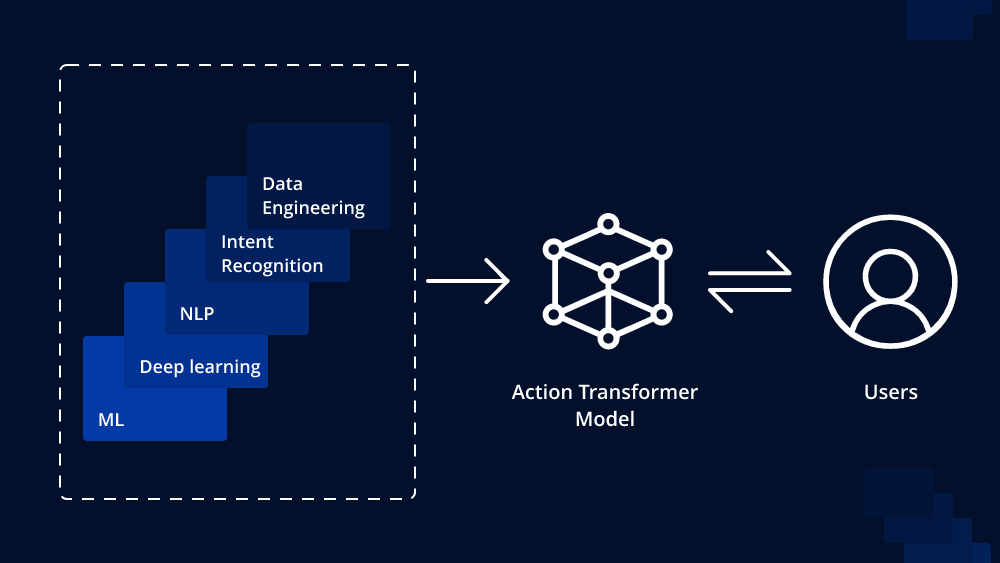
The Action Transformer model extends the traditional Transformer by introducing a dynamic action generation mechanism. Unlike standard Transformers, which are primarily used for sequence-to-sequence tasks like machine translation, Action Transformers excel in tasks where the output is not a fixed sequence but depends on the model’s actions during the generation process.

The concept of actions in an Action Transformer refers to the decisions made by the model during the decoding process. Instead of straightforwardly predicting each token in a sequential manner, the model actively selects actions that influence subsequent generations. This dynamic decision-making allows the Action Transformer to exhibit a more interactive and adaptive behavior during sequence generation.

How does an Action Transformer work?

  1. Action Space Definition: In an Action Transformer, the first step involves defining an action space. This space comprises a set of possible actions the model can take at each generation step. Actions can range from selecting a particular token from the vocabulary to applying various transformation operations on the current hidden state.
  2. Action Selection: During the decoding process, the Action Transformer chooses actions at each time step based on the context, current hidden state, and predefined action space. The model can also learn to assign probabilities to different actions, allowing it to make informed decisions during generation.
  3. Action Execution and Generation: After selecting an action, the Action Transformer performs the chosen action, which might involve appending a token to the output sequence or modifying the hidden state. The model then proceeds to the next generation step, and the process iterates until the desired sequence is generated or a predefined stopping condition is met.
  4. Feedback Loop: One key aspect of the Action Transformer is its ability to receive feedback on the impact of previously selected actions. This feedback loop enables the model to learn from its past decisions and adjust its behavior accordingly. Reinforcement learning techniques are often employed to optimize action selection policies based on the generated sequences’ quality.

Applications of Action Transformer Models

Action Transformer models have demonstrated their effectiveness in various NLP tasks, particularly those with complex and dynamic output generation requirements. Some prominent applications include:

  1. Dialogue Systems: Action Transformers are well-suited for building interactive dialogue systems, where the model engages in dynamic conversation and adapts its responses based on the user’s input.
  2. Code Generation: In programming-related tasks, Action Transformers can generate code snippets step-by-step, ensuring that each action taken is syntactically and semantically correct.
  3. Image Captioning: When generating captions for images, an Action Transformer can dynamically adjust the description based on the visual content and the generated text so far.

Conclusion

The Action Transformer model represents a significant advancement in sequence generation tasks within the NLP domain. By incorporating dynamic action selection and feedback mechanisms, the model gains the ability to make interactive and adaptive decisions during sequence generation. As researchers continue to explore and refine this architecture, we can expect Action Transformers to find broader applications in various real-world scenarios, further pushing the boundaries of natural language processing capabilities.

To Learn More:- https://www.leewayhertz.com/action-transformer-model/

Exploratory Data Analysis (EDA): Methods and Techniques

Exploratory Data Analysis (EDA) is a crucial initial step in the data analysis process, enabling data scientists, researchers, and analysts to understand the structure and patterns within a dataset. EDA involves a variety of methods and techniques to visually and quantitatively explore data, identify trends, patterns, outliers, and relationships between variables. This article will delve into what Exploratory Data Analysis entails, along with some common methods and techniques used in this process.

Understanding Exploratory Data Analysis (EDA)

EDA is all about understanding the data you are working with. It is a process of discovery that helps analysts gain insights and intuitions about the dataset before formal modeling or hypothesis testing begins. The primary objectives of EDA include:

  1. Data Summarization: Summarizing the main characteristics of the data, such as measures of central tendency, variability, and distributions.
  2. Data Visualization: Creating various visual representations, such as histograms, scatter plots, and box plots, to explore patterns and relationships in the data.
  3. Identifying Patterns: Spotting trends, clusters, and patterns within the dataset to understand underlying structures.
  4. Detecting Outliers: Identifying anomalies or extreme values that deviate significantly from the rest of the data.
  5. Feature Selection: Identifying relevant features or variables that contribute significantly to the analysis.
  6. Data Cleaning: Addressing missing or inconsistent data to ensure a reliable and accurate analysis.

Methods and Techniques of EDA

  1. Summary Statistics: Calculating summary statistics, such as mean, median, standard deviation, and percentiles, provides an initial understanding of the data’s central tendency and spread.
  2. Data Visualization: Data visualization is a cornerstone of EDA. Various charts and graphs help visualize the data’s distribution and relationships. Some common visualizations include:
  • Histograms: Representing the distribution of numerical data.
  • Box plots: Displaying the distribution of data and detecting outliers.
  • Scatter plots: Examining the relationship between two numerical variables.
  • Bar charts: Displaying the distribution of categorical data.
  • Heatmaps: Visualizing the correlation between variables.
  1. Correlation Analysis: EDA often involves analyzing correlations between variables. A correlation matrix or a correlation plot can provide insights into the strength and direction of relationships between different variables.
  2. Outlier Detection: Identifying outliers is critical to understanding potential errors or anomalies in the dataset. Techniques like Z-score analysis or the use of box plots can help spot outliers.
  3. Data Imputation: Dealing with missing data is essential during EDA. Imputation techniques, such as mean imputation or interpolation, help estimate missing values.
  4. Dimensionality Reduction: In datasets with a large number of features, dimensionality reduction techniques like Principal Component Analysis (PCA) can help simplify the analysis by reducing the number of variables while preserving important information.
  5. Clustering Analysis: Clustering algorithms, such as k-means, can be used to group similar data points together, revealing underlying patterns in the data.
  6. Time Series Analysis: For time-series data, techniques like seasonality decomposition, autocorrelation, and lag plots can help understand temporal patterns.

The Importance of EDA

EDA is not just a preliminary step but a crucial part of the entire data analysis process. It helps analysts gain valuable insights, identify potential issues, and make informed decisions about subsequent steps in the analysis. Through EDA, analysts can discover hidden patterns, relationships, or trends that might not be apparent through simple data modeling. Moreover, it facilitates effective communication of findings to stakeholders, making complex data more understandable and actionable.

In conclusion, Exploratory Data Analysis (EDA) plays a fundamental role in understanding and extracting meaningful information from data. By employing a variety of methods and techniques, analysts can uncover valuable insights and set the stage for more advanced data modeling and hypothesis testing. As data continues to play an increasingly crucial role in decision-making across various domains, the significance of EDA in harnessing the full potential of data cannot be overstated.

To Learn More:- https://www.leewayhertz.com/what-is-exploratory-data-analysis/

How to Build a Machine Learning App

Machine learning has rapidly evolved over the past few years, and its applications have become widespread across various industries. One of the most exciting and practical ways to implement machine learning is by building machine learning apps. These apps leverage the power of artificial intelligence to provide personalized and intelligent user experiences. In this article, we will guide you through the process of building a machine learning app, from conceptualization to deployment.

  1. Define the Problem and Scope:
    The first step in building a machine learning app is to clearly define the problem you want to solve and understand the scope of your application. Whether it’s a recommendation system, image recognition, or natural language processing, a well-defined problem will guide your development process.
  2. Data Collection and Preprocessing:
    Machine learning models heavily rely on data, so collecting and preprocessing the right dataset is crucial. Ensure that your data is accurate, relevant, and properly labeled for supervised learning tasks. Additionally, clean and preprocess the data to remove any noise or inconsistencies that could negatively impact the model’s performance.
  3. Select the Right Algorithm:
    Choosing the appropriate machine learning algorithm is vital for the success of your app. The choice depends on the problem type (classification, regression, clustering, etc.) and the nature of the data. Popular algorithms include Support Vector Machines, Random Forests, Neural Networks, and K-Nearest Neighbors. Experiment with different algorithms to find the one that yields the best results for your specific task.
  4. Develop the App’s Interface:
    The user interface is what users interact with, so it must be intuitive and user-friendly. Decide on the platform for your app (web, mobile, desktop) and design an interface that allows users to access the machine learning features seamlessly. Ensure that the app’s design aligns with your target audience’s preferences and provides a smooth user experience.
  5. Implement Machine Learning Model:
    Integrate the chosen machine learning algorithm into your app’s architecture. Depending on your expertise, you may write the machine learning code from scratch or leverage popular machine learning libraries such as TensorFlow, PyTorch, or scikit-learn. Train your model on the preprocessed data, fine-tuning hyperparameters for optimal performance.
  6. Real-time Inference:
    In a machine learning app, real-time inference is crucial. Users expect fast and accurate results, so optimize your model for quick predictions. Techniques like model quantization and on-device inferencing can significantly improve inference speed, making your app more responsive.
  7. Error Handling and Debugging:
    Machine learning models may encounter errors or produce unexpected results. Implement proper error handling and debugging mechanisms to ensure that your app provides meaningful responses to users, even in unforeseen situations. Well-written error messages can prevent user frustration and help improve the app’s reliability.
  8. Ensure Security and Privacy:
    When dealing with user data, security and privacy are of utmost importance. Implement data encryption and secure communication protocols to protect sensitive information. Ensure compliance with data protection regulations and obtain user consent for data collection and processing.
  9. Test Rigorously:
    Thorough testing is essential to identify and fix any bugs or issues before releasing your app to the public. Conduct unit tests, integration tests, and user testing to validate the app’s functionality, performance, and user experience. Utilize A/B testing to compare different versions and gather user feedback for further improvements.
  10. Deploy and Monitor:
    Once your machine learning app has passed all the testing phases, it’s time to deploy it to your target platform. Monitor the app’s performance and user feedback continuously. Use analytics tools to track user behavior and engagement, allowing you to make data-driven decisions for future updates and enhancements.

Conclusion:
Building a machine learning app is an exciting journey that requires careful planning, data handling, algorithm selection, and user-centric design. By following the steps outlined in this article and keeping the user’s needs at the forefront, you can create a successful machine learning app that delights users with its intelligence and functionality. Remember that continuous improvement is key, so listen to user feedback and stay up-to-date with the latest advancements in the field of machine learning to keep your app at the cutting edge.

To Learn More:- https://www.leewayhertz.com/how-to-build-a-machine-learning-app/

10 Ways Generative AI is Revolutionizing Healthcare

The integration of Artificial Intelligence (AI) in healthcare has been transforming the industry, making processes more efficient, and improving patient outcomes. One specific subset of AI, known as Generative AI, has emerged as a powerful tool in this domain. Generative AI utilizes machine learning algorithms to create new data based on existing patterns and information. In healthcare, it holds enormous potential to advance diagnostics, treatment options, and overall patient care. In this article, we will explore ten ways Generative AI is revolutionizing the healthcare landscape.

  1. Medical Image Generation:
    Generative AI excels at creating synthetic images that closely resemble real medical data. By training on vast datasets of radiology images, such as X-rays, MRIs, and CT scans, Generative AI can produce accurate, detailed images. This capability not only aids in augmenting medical image datasets for better training models but also enhances the quality of images for research purposes.
  2. Disease Detection and Diagnosis:
    Generative AI can learn to identify complex patterns in medical data, enabling it to detect early signs of diseases that might go unnoticed by human eyes. For instance, Generative AI can be employed to analyze retinal scans for diabetic retinopathy, facilitating early diagnosis and treatment.
  3. Drug Discovery:
    Traditional drug discovery is a time-consuming and expensive process. Generative AI offers a promising solution by generating molecular structures that could be potential drug candidates. This accelerates the drug discovery process, leading to the development of new medications for various conditions.
  4. Personalized Treatment Plans:
    Each patient is unique, and their response to treatments may vary. Generative AI can analyze a patient’s medical history, genetics, and lifestyle to create personalized treatment plans. This individualized approach enhances treatment effectiveness, reduces adverse effects, and improves patient satisfaction.
  5. Virtual Patient Models:
    Generative AI can create virtual patient models that closely resemble real individuals, but with a twist: they can simulate various medical conditions. These models enable healthcare professionals to practice complex procedures, develop new surgical techniques, and improve their skills without risking real patients’ lives.
  6. Natural Language Generation in Electronic Health Records (EHRs):
    EHRs are abundant with valuable patient data. Generative AI can sift through this wealth of information and generate concise, readable narratives about a patient’s medical history, test results, and treatment progress. This enhances communication among healthcare providers and reduces the time spent on documentation.
  7. Mental Health Support:
    Generative AI-powered chatbots and virtual assistants can offer valuable mental health support to patients. By simulating empathetic conversations, they provide an accessible and confidential platform for individuals to discuss their emotional struggles, reducing the stigma associated with seeking help.
  8. Predictive Analytics:
    Generative AI can forecast potential disease outbreaks and health trends by analyzing vast amounts of health-related data. By identifying patterns and risk factors, healthcare organizations can proactively allocate resources, plan interventions, and improve community health.
  9. Rehabilitation Assistance:
    For patients recovering from injuries or surgeries, Generative AI can provide personalized rehabilitation plans. By monitoring patient progress, analyzing data, and adjusting routines accordingly, AI-powered systems enhance the effectiveness of rehabilitation therapies.
  10. Medical Education and Training:
    Generative AI is transforming medical education by creating interactive and immersive learning experiences. Medical students can use AI-generated simulations to practice clinical skills, enhance medical knowledge, and develop critical decision-making abilities.

Conclusion:

The application of Generative AI in healthcare is undeniably shaping the future of medicine. Its potential to generate realistic medical data, assist in diagnostics, expedite drug discovery, and provide personalized care is truly revolutionary. As the technology continues to evolve, it is crucial to ensure ethical considerations, data privacy, and regulatory compliance to harness Generative AI’s power responsibly. As a result, healthcare professionals, patients, and the industry as a whole can benefit from these remarkable advancements in patient care and medical research.

To Learn More:- https://www.leewayhertz.com/generative-ai-in-healthcare

AI Use Cases and Applications in Private Equity & Principal Investment

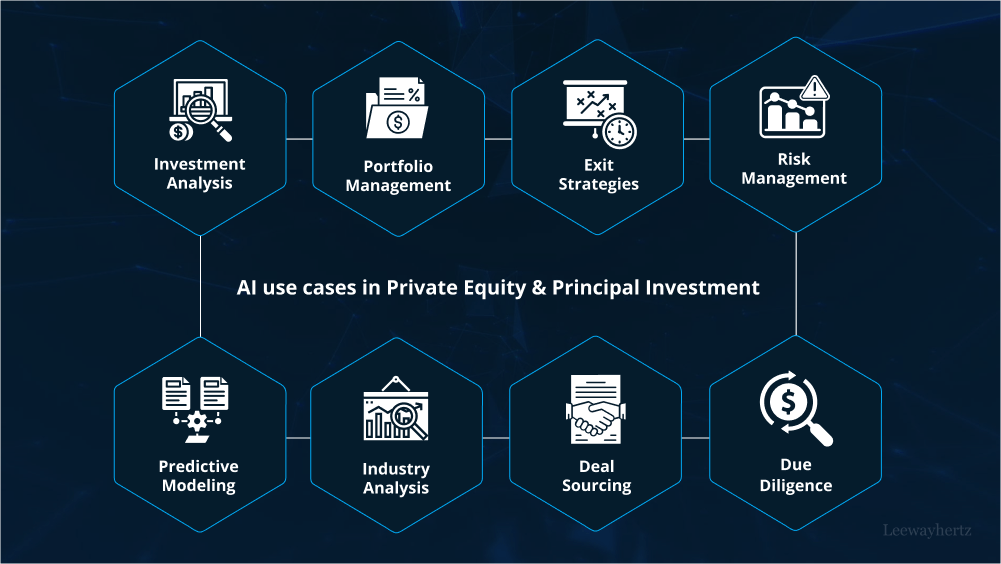
In recent years, the private equity and principal investment industries have witnessed a transformational impact from artificial intelligence (AI) technologies. These advanced algorithms and machine learning capabilities have enabled firms to make data-driven decisions, optimize investment strategies, and uncover valuable insights in an increasingly complex market landscape. This article explores the diverse use cases and applications of AI in private equity and principal investment, highlighting how these technologies are reshaping the industry.

  1. Data-driven Investment Decisions:

AI has revolutionized the way investment decisions are made by processing vast amounts of structured and unstructured data. Machine learning algorithms can analyze historical financial data, market trends, and company performance to identify potential investment opportunities. By leveraging AI, private equity firms can access deeper insights and predictive models, thus improving their investment selection process and overall returns.

  1. Risk Assessment and Mitigation:

AI plays a crucial role in risk assessment and mitigation strategies. Advanced algorithms can assess the risk associated with specific investments by considering various factors, including market volatility, economic indicators, and sector-specific trends. This analysis aids in optimizing portfolio diversification and managing potential risks, ultimately leading to better risk-adjusted returns.

  1. Enhanced Due Diligence:

During the due diligence phase, AI-driven tools can accelerate the process and provide more comprehensive analysis. Natural language processing (NLP) algorithms can efficiently review legal documents, financial statements, and contracts to identify potential red flags or opportunities. AI-driven due diligence also allows investment professionals to focus on higher-value tasks, making the process more efficient and effective.

  1. Sentiment Analysis:

AI-powered sentiment analysis helps investors gauge public perception and sentiment surrounding a specific company or sector. By monitoring social media, news articles, and other online sources, private equity firms can gain valuable insights into the market sentiment towards potential investments. This information aids in making informed decisions and adapting investment strategies accordingly.

  1. Portfolio Optimization:

AI algorithms can continuously analyze portfolio performance and market conditions to optimize asset allocation. By adjusting investments in real-time based on market shifts and performance indicators, private equity firms can maximize returns and minimize exposure to risk. This level of dynamic portfolio management was previously unattainable without the power of AI.

  1. Deal Sourcing and Lead Generation:

AI has enabled private equity firms to discover new investment opportunities through deal sourcing and lead generation. Automated processes can scan vast amounts of data to identify potential targets and trends that align with investment objectives. This reduces manual efforts and expands the scope of opportunities, making the sourcing process more efficient and effective.

  1. Valuation Modeling:

AI can significantly impact valuation modeling by incorporating advanced statistical techniques and machine learning algorithms. These models can analyze financial metrics, industry benchmarks, and comparable transactions to produce more accurate and reliable valuations. Enhanced valuation models contribute to more precise pricing during acquisitions and divestments.

  1. Exit Strategy Optimization:

AI technologies can also assist in optimizing exit strategies. By analyzing market conditions, industry trends, and financial indicators, AI algorithms can suggest the best timing and method for exit. This results in improved exit valuations and higher returns on investments.

  1. Regulatory Compliance:

Private equity and principal investment firms must navigate complex regulatory environments. AI can help by automating compliance monitoring and ensuring adherence to relevant regulations. Through AI-driven compliance solutions, firms can reduce the risk of non-compliance and associated penalties.

Conclusion:

AI has emerged as a game-changer for the private equity and principal investment industries. The applications of AI, from data-driven investment decisions to regulatory compliance, have revolutionized how investments are managed, risk is assessed, and opportunities are uncovered. As the technology continues to evolve, its integration in the sector is likely to deepen, providing firms with even greater potential for success in the future. However, as with any technology, it is essential to balance the power of AI with human expertise to achieve optimal outcomes in the highly dynamic and competitive world of private equity and principal investment.

To Learn More:- https://www.leewayhertz.com/ai-use-cases-in-private-equity-and-principal-investment/

How to Secure AI Models – Techniques for Enhanced AI Model Security

As Artificial Intelligence (AI) continues to revolutionize industries and become an integral part of our daily lives, ensuring the security of AI models becomes paramount. AI model security is essential to safeguard against potential vulnerabilities, attacks, and privacy breaches. In this article, we will explore several techniques that can be employed to enhance the security of AI models, protecting both users and sensitive data.

  1. Data Privacy and Anonymization
    Protecting data privacy is crucial in AI model security. Before training an AI model, it is essential to anonymize or de-identify sensitive information. Techniques such as differential privacy and data perturbation can be utilized to add noise to the data, making it challenging for adversaries to extract sensitive information.
  2. Model Encryption
    Model encryption involves encoding the AI model’s parameters and architecture to prevent unauthorized access. Utilizing techniques like homomorphic encryption enables computations to be performed on encrypted data directly, ensuring data confidentiality during inference.
  3. Adversarial Training
    AI models are susceptible to adversarial attacks, where malicious input data can cause the model to produce erroneous results. Adversarial training involves augmenting the training data with adversarial examples, making the model robust against potential attacks.
  4. Model Watermarking
    Model watermarking is a technique used to embed a unique identifier into the AI model, allowing developers to trace the model’s origin and detect unauthorized usage or distribution.
  5. Secure Federated Learning
    Federated learning allows AI models to be trained across multiple devices without sharing raw data centrally. Employing secure federated learning techniques like secure aggregation and encrypted updates ensures that sensitive data remains protected during the collaborative training process.
  6. Secure Model Serving
    The process of deploying AI models in production introduces security risks. Utilizing secure model serving frameworks ensures that only authorized users can access and interact with the AI model’s API, mitigating potential attacks on the deployed system.
  7. Continuous Monitoring and Updates
    AI model security is an ongoing process. Continuous monitoring of AI models in production can help identify and address vulnerabilities in real-time. Regular updates and patches should be applied to keep the model resilient against emerging threats.
  8. AI Model Auditing
    Conducting regular audits of AI models aids in identifying potential security flaws and ensuring compliance with established security standards. Third-party audits by security experts can provide an unbiased assessment of an AI model’s security posture.
  9. Restricted Access to AI Model Training
    Limiting access to AI model training environments and datasets to authorized personnel helps prevent unauthorized modifications or data breaches during the model development phase.
  10. Model Explainability and Interpretability
    Enhancing AI model security also involves understanding model decisions. Utilizing techniques for model explainability and interpretability helps identify potential biases and vulnerabilities, making the model more trustworthy and secure.
  11. Containerization
    Containerization, using technologies like Docker, provides a secure and isolated environment for running AI models, reducing the risk of potential attacks on the underlying system.

Conclusion

AI model security is a critical aspect of the AI development lifecycle. Employing the above-mentioned techniques can significantly enhance the security of AI models, safeguarding against potential threats and protecting sensitive data. As the field of AI continues to evolve, staying vigilant and proactive in addressing security concerns will be vital to building trustworthy and reliable AI systems that benefit society without compromising privacy and safety. By prioritizing AI model security, we can fully harness the potential of AI technology for a brighter and more secure future.

To Learn More:- https://www.leewayhertz.com/ai-model-security/

How to Build Generative AI Models for Image Synthesis

Generative Artificial Intelligence (AI) models have gained significant attention in recent years for their ability to create new and realistic images. With advancements in deep learning and neural networks, it has become easier to build and train generative AI models for image synthesis. In this article, we will explore the key steps involved in building such models.

  1. Define the Problem: The first step is to clearly define the problem statement for image synthesis. This could involve generating realistic human faces, creating new artworks, or even transforming images from one style to another. Defining the problem helps in selecting the appropriate model architecture and dataset.
  2. Gather and Preprocess Data: To train a generative AI model, you need a diverse dataset of images. Collect a large number of images that represent the desired output. It is essential to preprocess the data by normalizing pixel values, resizing images to a consistent size, and augmenting the dataset to increase its variability.
  3. Choose a Model Architecture: There are various generative AI models suitable for image synthesis, such as Generative Adversarial Networks (GANs), Variational Autoencoders (VAEs), and Autoregressive Models. Each model has its advantages and limitations. GANs are particularly popular due to their ability to produce highly realistic images.
  4. Train the Model: Training a generative AI model involves feeding the dataset into the chosen architecture and optimizing its parameters. The model learns to generate images by iteratively adjusting its internal weights based on the provided data. This process requires substantial computational resources and can take several hours or even days, depending on the complexity of the model and the size of the dataset.
  5. Evaluate and Fine-tune: After training, it is crucial to evaluate the performance of the model. Common evaluation metrics include image quality, diversity, and similarity to the target distribution. If the results are unsatisfactory, fine-tuning the model by adjusting hyperparameters or adding regularization techniques can help improve the image synthesis output.
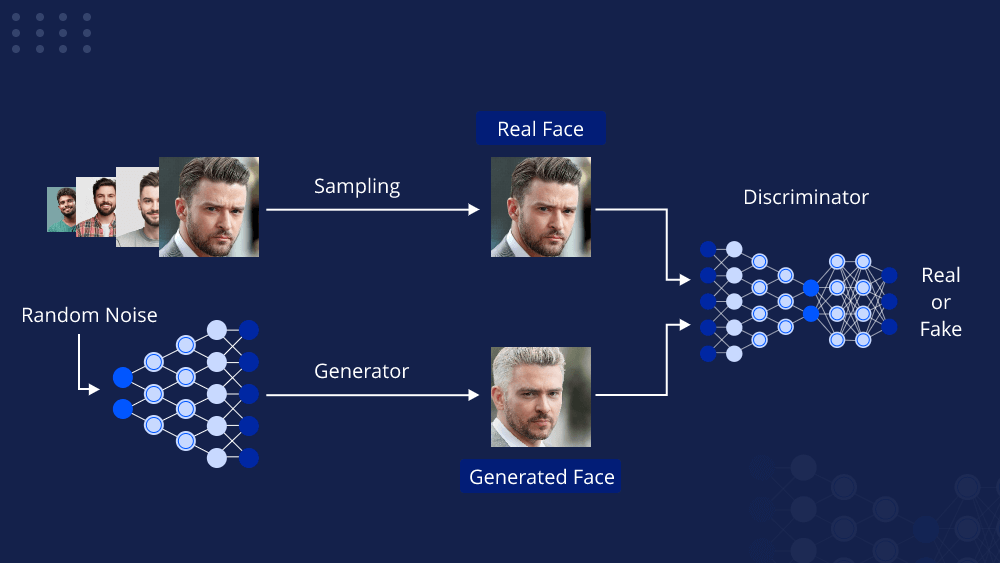
  6. Generate New Images: Once the model is trained and fine-tuned, you can start generating new images. By providing random noise or a latent vector as input to the model, it will produce a synthesized image that fits the learned distribution. You can experiment with different inputs to explore the creativity of the model and generate a wide range of images.
  7. Post-process and Refine: The generated images might require post-processing and refinement to enhance their quality. Techniques such as image filtering, color correction, and image blending can be applied to make the images more visually appealing and coherent.
  8. Ethical Considerations: When building generative AI models, it is important to consider ethical implications. Ensure that the model does not generate harmful or offensive content. Avoid using copyrighted images or violating privacy rights. Be mindful of biases in the training data that could result in biased outputs.
  9. Continual Learning: Building generative AI models is an iterative process. Continually improve the model by incorporating feedback from users and refining the training process. Monitor the model’s performance and retrain it periodically with updated datasets to keep up with changing trends and improve its image synthesis capabilities.
  10. Share and Collaborate: Lastly, share your generative AI models and findings with the AI community. Collaborate with researchers and developers to push the boundaries of image synthesis. Sharing knowledge and experiences can lead to further advancements in the field.

In conclusion, building generative AI models for image synthesis involves a series of steps, including problem definition, data collection, model selection, training, evaluation, and fine-tuning. With careful implementation and consideration of ethical implications, these models have the potential to generate realistic and creative images across various domains.

To Learn More:- https://www.leewayhertz.com/a-guide-on-generative-ai-models-for-image-synthesis/

What Are Foundation Models and the Need for a Foundation Model

In the realm of natural language processing (NLP) and artificial intelligence (AI), foundation models have emerged as a powerful and versatile tool. These models, such as OpenAI’s GPT-3, serve as the building blocks for various applications and advancements in the field. They are trained on massive amounts of text data, enabling them to understand and generate human-like language. Here, we delve into what foundation models are and explore the need for a foundation model in the ever-evolving landscape of AI.

1. Definition of Foundation Models:

  • Foundation models are large-scale neural networks trained on diverse and extensive datasets.
  • They possess the capability to understand, generate, and manipulate natural language.
  • These models form the basis for developing applications such as chatbots, language translation, text summarization, and more.

2. Training Process:

  • Foundation models are pre-trained on a vast corpus of text from the internet, including books, articles, and websites.
  • They learn to predict the next word in a sentence based on the context provided by the preceding words.
  • The training process involves numerous iterations, refining the model’s language comprehension and generation abilities.

3. Language Understanding:

  • Foundation models excel in understanding the nuances of human language.
  • They can comprehend context, disambiguate between multiple meanings, and grasp the underlying semantics.
  • This understanding enables them to provide accurate responses and generate coherent text.

4. Language Generation:

  • Foundation models are adept at generating human-like text.
  • They can generate creative stories, write code snippets, draft emails, and compose articles.
  • The generated text is contextually relevant and often indistinguishable from human-written content.

5. Versatility and Adaptability:

  • Foundation models can be fine-tuned for specific tasks.
  • By training them on domain-specific data, they can provide more accurate and specialized outputs.
  • Fine-tuning allows developers to customize the models according to their application requirements.

6. Efficiency and Cost-Effectiveness:

  • The availability of foundation models eliminates the need for building models from scratch, saving time and resources.
  • Developers can leverage these models as a starting point, focusing their efforts on fine-tuning and tailoring them to specific tasks.
  • This approach reduces development costs and accelerates the deployment of AI-powered applications.

7. Democratizing AI:

  • Foundation models have the potential to democratize AI by making advanced language processing capabilities accessible to a wider audience.
  • With the availability of pre-trained models, developers with varying levels of expertise can create sophisticated NLP applications.
  • This opens up opportunities for innovation and empowers individuals and organizations to harness the power of AI.

8. Ethical Considerations:

  • As foundation models become increasingly powerful, ethical considerations become crucial.
  • Ensuring models are unbiased, fair, and aligned with human values is of paramount importance.
  • Continuous research and development are necessary to address ethical challenges and mitigate potential risks.

In conclusion, foundation models have revolutionized the field of natural language processing and AI. With their ability to understand and generate human-like language, these models serve as the bedrock for a wide range of applications. The need for foundation models arises from their efficiency, versatility, and potential to democratize AI. However, ethical considerations must be a priority as these models continue to evolve and shape the future of AI.

To Learn More:- https://www.leewayhertz.com/foundation-models/

Exploring the Services of Action Transformer

In recent years, there has been a growing demand for advanced technologies that can automate and optimize various processes across industries. One such breakthrough innovation is the Action Transformer Services, a powerful tool that combines the capabilities of natural language processing and machine learning algorithms to enhance efficiency and automation. Let’s delve into the key points of this transformative technology:

Introduction to Action Transformer Services:

  • Action Transformer Services leverage the Transformer architecture, a state-of-the-art deep learning model, to process and understand natural language inputs.
  • These services enable businesses to automate tasks, streamline workflows, and improve overall operational efficiency.

Natural Language Understanding (NLU):

  • Action Transformer Services excel in understanding and interpreting natural language inputs, enabling them to comprehend complex instructions and queries.
  • NLU capabilities enable businesses to automate customer support, analyze feedback, and extract valuable insights from unstructured text data.

Task Automation:

  • Leveraging the power of machine learning, Action Transformer Services can automate a wide range of tasks, including data entry, document processing, and content generation.
  • By automating repetitive and time-consuming tasks, businesses can free up their workforce to focus on more strategic and creative endeavors.

Customization and Adaptability:

  • Action Transformer Services can be customized and fine-tuned to meet specific business requirements.
  • Through training on domain-specific data, these services can adapt to industry-specific jargon, context, and nuances, making them highly versatile and effective.

Improved Decision-Making:

  • By analyzing vast amounts of data and extracting relevant information, Action Transformer Services can provide valuable insights to support decision-making processes.
  • These services assist in forecasting, risk analysis, and recommendation systems, helping businesses make informed choices and improve their outcomes.

Enhanced Communication:

  • Action Transformer Services can facilitate seamless communication between humans and machines.
  • They can assist in creating chatbots, virtual assistants, and voice-controlled systems that understand and respond to user queries and commands accurately and efficiently.

Increased Productivity:

  • With the automation capabilities of Action Transformer Services, businesses can significantly increase productivity and output.
  • By reducing manual efforts and minimizing errors, these services enable faster and more accurate completion of tasks.

Integration with Existing Systems:

  • Action Transformer Services can be easily integrated with existing software and systems, making it convenient for businesses to adopt and implement this technology.
  • Integration ensures a smooth transition and allows organizations to leverage the benefits of automation without disrupting their established workflows.

Ethical Considerations:

  • As with any technology, ethical considerations must be taken into account while deploying Action Transformer Services.
  • Privacy, data security, and bias mitigation are crucial aspects that need careful attention to ensure responsible and fair usage of this technology.

Future Prospects:

  • Action Transformer Services hold immense potential for further advancements and innovations.
  • Continued research and development in the field of natural language processing and machine learning will likely lead to more sophisticated and capable versions of this technology.

In conclusion, Action Transformer Services have emerged as a game-changer in the realm of automation and efficiency. By combining natural language understanding and machine learning algorithms, these services empower businesses to automate tasks, streamline workflows, and improve overall productivity. With their adaptability, customization options, and integration capabilities, Action Transformer Services offer a versatile and scalable solution for businesses across various industries. As technology continues to evolve, we can expect even more groundbreaking applications and advancements in the realm of Action Transformer Services.

To Learn More:- https://www.leewayhertz.com/hire-action-transformer-developers/

Design a site like this with WordPress.com
Get started